


Coding and Billing for Mental Health Services in USA: Complete Guide for Providers
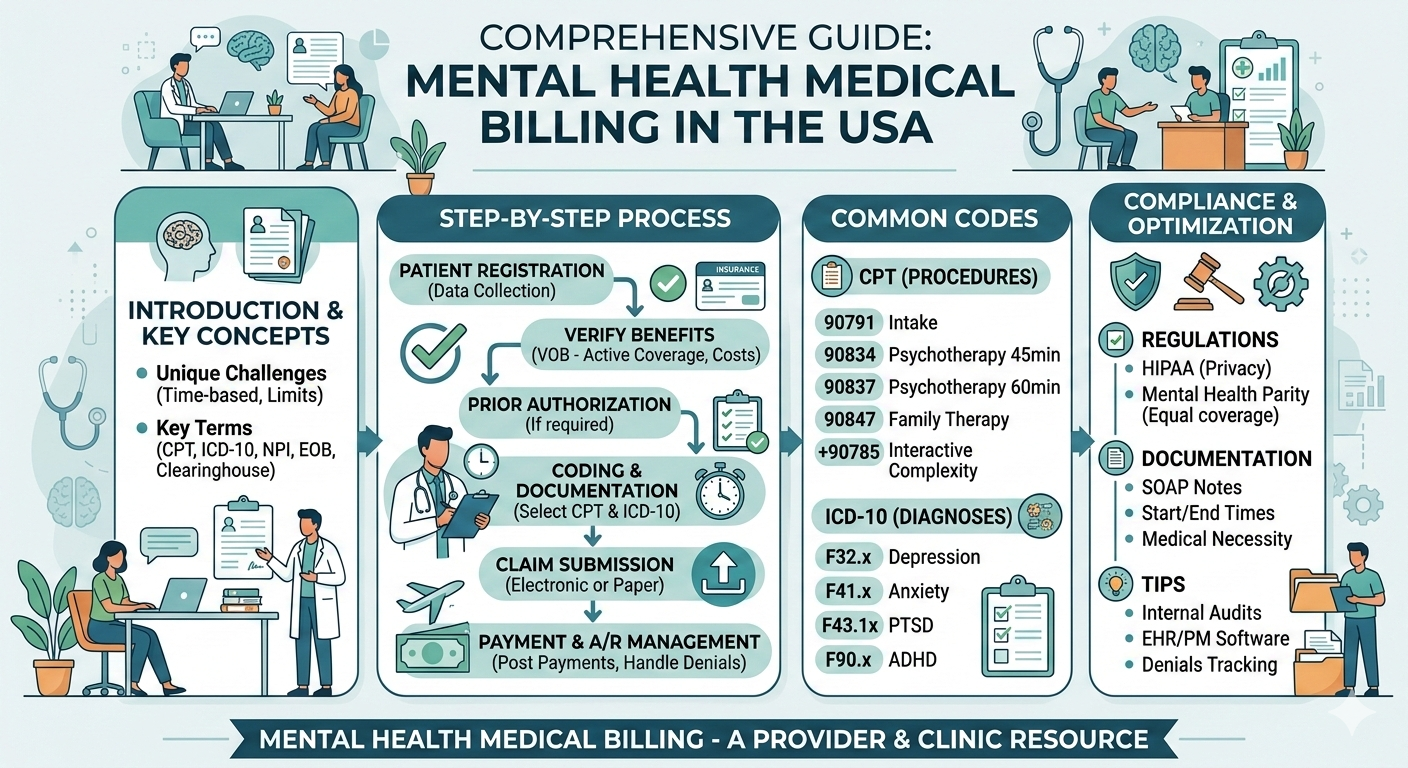
Mental health practices across the United States are growing rapidly, but so are regulatory challenges and payer complexities. From private therapy offices to multi-provider behavioral health clinics, accurate coding and billing for mental health services has become a critical factor in financial stability.
In this guide, you will learn:
-
How coding rules differ for therapy, psychiatry, and telehealth
-
Common CPT and ICD-10 errors that lead to denials
-
Medicare and commercial payer requirements
-
The role of credentialing in reimbursement
-
When outsourcing becomes a smart strategic move
Whether you are a solo therapist or managing a group clinic, understanding billing for mental health services is essential to protect revenue and reduce compliance risk.
Understanding Coding and Billing for Mental Health Services
Coding and billing for mental health services involves translating therapy sessions, psychiatric evaluations, medication management, and telehealth visits into standardized CPT and ICD-10 codes. These codes communicate to insurance payers what service was delivered and why it was medically necessary.
Unlike many other specialties, mental health medical billing requires careful documentation of time, medical necessity, treatment plans, and progress notes. Even small documentation gaps can trigger denials.
Key components include:
-
Accurate CPT selection (90834, 90837, 90791, 99213 with psychotherapy add-ons, etc.)
-
Proper ICD-10 diagnosis coding
-
Modifier usage for telehealth and place of service
-
Coordination of benefits when patients have multiple plans
Billing mental health claims is not just administrative work; it directly affects cash flow, compliance, and patient satisfaction.
Core CPT Codes Used in Mental Health Billing
Therapists, psychologists, and psychiatrists rely on time-based psychotherapy codes. The most commonly used include:
-
90791 Psychiatric diagnostic evaluation
-
90832 30-minute psychotherapy
-
90834 45-minute psychotherapy
-
90837 60-minute psychotherapy
-
90846 and 90847 Family psychotherapy
-
99202–99215 Evaluation and management codes for psychiatrists
Incorrect time documentation is one of the biggest reasons billing for mental health therapists gets rejected. If documentation does not support session length, payers will downcode or deny the claim.
This is why many providers work with mental health billing specialist companies that understand payer-specific nuances.
ICD-10 Diagnosis Coding and Medical Necessity
Mental health claims are heavily scrutinized for medical necessity. Proper use of ICD-10 codes such as F32.1 (Major depressive disorder), F41.1 (Generalized anxiety disorder), and F43.10 (PTSD) is essential.
Payers expect:
-
A clear diagnosis
-
A treatment plan
-
Ongoing progress documentation
-
Evidence of symptom severity
Medical billing for mental health requires clinical alignment. Coding cannot stand alone without documentation that supports it.
Billing Medicare for Mental Health Services
Billing Medicare for mental health services comes with unique requirements. Medicare covers psychotherapy, psychiatric evaluations, medication management, and certain telehealth services. However:
-
Documentation must justify medical necessity
-
Providers must be properly credentialed
-
Telehealth rules must follow CMS guidelines
-
Certain services may have frequency limitations
Medicare audits in behavioral health have increased in recent years. Errors in place-of-service codes or missing signatures often lead to recoupments.
For providers new to Medicare, working with a mental health billing services company that understands CMS regulations can significantly reduce compliance risk.
Telehealth and Behavioral Health Billing
Since the pandemic, teletherapy has become mainstream. Behavioral and mental health billing services must now account for:
-
Telehealth modifiers (95, GT depending on payer)
-
Place of service 02 or 10
-
State-specific licensure compliance
-
Cross-state insurance rules
Billing for mental health providers offering telehealth requires careful tracking of payer updates, which frequently change.
Credentialing and Its Impact on Reimbursement
Before submitting claims, providers must complete credentialing with insurance payers. Mental health billing and credentialing services often go hand in hand because delayed credentialing can stall revenue for months.
Common credentialing challenges include:
-
CAQH profile errors
-
Missing malpractice documentation
-
Contract rate negotiation
-
Re-credentialing cycles
A mental health billing company that also handles credentialing ensures faster payer enrollment and smoother claims processing.
Common Denial Reasons in Mental Health Billing
Mental health billing faces several recurring denial patterns:
-
Incorrect CPT time documentation
-
Diagnosis not supporting medical necessity
-
Authorization missing
-
Credentialing not active
-
Duplicate claims
-
Coordination of benefits errors
Billing for mental health clinics with multiple providers adds complexity. Each clinician must be credentialed correctly, and claims must reflect the rendering provider accurately.
When denial rates exceed industry benchmarks, many practices consider outsourcing mental health billing and coding to experienced teams.
In-House vs Outsourced Billing for Mental Health
Small practices often start with in-house billing. However, as volume grows, complexity increases. Outsourced billing for mental health becomes attractive when:
-
Claim denials exceed 8–10 percent
-
Staff turnover disrupts operations
-
Authorization tracking becomes inconsistent
-
Revenue cycle reporting lacks transparency
Outsourcing mental health billing allows providers to focus on patient care rather than insurance follow-ups.
Billing companies for mental health typically offer:
-
Claims submission and tracking
-
Denial management
-
AR follow-up
-
Payment posting
-
Reporting dashboards
The best outsource mental health billing and coding services combine compliance expertise with revenue cycle optimization.
How to Choose the Right Mental Health Billing Partner
Selecting a top mental health billing company requires careful evaluation. Providers should assess:
-
Behavioral health specialization
-
Knowledge of Medicare and Medicaid rules
-
Experience with group therapy billing
-
Transparent pricing structure
-
Real-time reporting access
Not every cheap outsource mental health billing company delivers quality. Low-cost services sometimes lack compliance expertise, leading to long-term financial risk.
A best mental health billing services company will demonstrate:
-
Proven denial reduction strategies
-
Dedicated account management
-
Credentialing support
-
HIPAA compliance
-
Consistent communication
The best mental health billing company acts as an extension of your practice rather than just a vendor.
Revenue Cycle Management in Mental Health
Mental health billing solutions should go beyond claim submission. A complete revenue cycle includes:
-
Eligibility verification
-
Benefits breakdown
-
Authorization tracking
-
Accurate coding
-
Claims submission
-
Denial management
-
Patient billing
-
Reporting and analytics
Medical billing for mental health is strongest when supported by a structured revenue cycle management process.
Mental health billing services that integrate data tracking can identify patterns such as high denial CPT codes, payer delays, and underpayments.
Special Considerations for Group Practices and Clinics
Billing services for mental health clinics require multi-provider coordination. This includes:
-
Individual NPI tracking
-
Group NPI billing rules
-
Supervision billing scenarios
-
Split billing for medication and therapy
Mental health billing specialist companies experienced in clinic environments understand how to structure workflows efficiently.
For growing organizations, partnering with a mental health billing company early prevents revenue leaks later.
Compliance and Audit Preparedness
Behavioral health is subject to frequent audits. Compliance requires:
-
Accurate time documentation
-
Signed treatment plans
-
Secure record storage
-
Consistent diagnosis updates
Mental health billing and coding services should include internal quality checks before claims submission. This reduces post-payment audits and repayment demands.
The Strategic Value of Outsourcing
Outsourcing mental health billing is no longer just a cost-saving measure. It is a strategic growth decision. When handled correctly, it can:
-
Reduce claim denial rates
-
Improve clean claim ratios
-
Shorten days in AR
-
Increase overall collections
-
Provide predictable revenue
The right mental health billing services company supports scalability while maintaining regulatory compliance.
Partnering with an Experienced Revenue Cycle Team
For practices seeking structured growth, companies like 247 medical billing services provide comprehensive support including medical billing services, medical coding services, medical billing and coding services, revenue cycle management, and credentialing services tailored to behavioral health providers.
By combining operational expertise with specialty-specific knowledge, such partnerships strengthen billing for mental health providers and create sustainable financial performance.
Conclusion
Coding and billing for mental health services in the United States requires precision, compliance awareness, and ongoing payer education. From CPT selection to Medicare rules and credentialing processes, each step influences reimbursement outcomes.
Practices that invest in structured mental health billing systems or collaborate with experienced billing services for mental health gain more than administrative support. They gain financial clarity, reduced stress, and the freedom to focus on patient care.
Frequently Asked Questions
What makes mental health billing different from other specialties?
Mental health billing is largely time-based and heavily documentation-driven. Claims require proof of medical necessity, accurate session duration, and compliant diagnosis coding.
Is billing Medicare for mental health services complicated?
Yes. Medicare has strict documentation and telehealth requirements. Incorrect modifiers or missing notes often lead to denials or audits.
Should therapists outsource billing?
If denial rates are high, administrative workload is overwhelming, or compliance risk is increasing, outsourcing mental health billing and coding may improve revenue stability.
How do I select the best mental health billing services company?
Look for behavioral health specialization, transparent reporting, credentialing support, and proven denial reduction performance rather than choosing solely based on cost.
Do mental health billing services include credentialing?
Many providers offer mental health billing and credentialing services together to ensure faster payer enrollment and smoother reimbursement processes.
Can small practices afford outsourced billing for mental health?
Yes. Many billing companies for mental health work on percentage-based models, making professional revenue cycle support accessible to small and mid-sized practices.
Catégories
Lire la suite
In a bold move, Netflix has greenlit an ambitious new science fiction series titled "Another Life," featuring Katee Sackhoff in the lead role as astronaut Niko Breckenridge. The series follows Commander Breckenridge and her crew as they embark on a perilous journey to investigate a mysterious alien artifact's origins. The high-stakes mission quickly escalates into a potentially fatal...

Jessie's presence on the battlefield is a significant force multiplier, though her mechanical genius arguably surpasses even her inspirational value. Her primary utility shines in expedition-focused gameplay. The expedition skill 'Stand of Arms,' when maximized, grants a formidable 25% damage increase to all troop types. This makes her a premier lead hero for activities like Bear Hunt and...
Locating the Geiger Counter Since the Headwinds update, locating a Geiger Counter in Arc Raiders has become a crucial part of gameplay. However, pinpointing its exact location can be quite challenging. This rare and valuable item is exclusively found on Stella Montis, a map known for its extreme conditions and unforgiving terrain. Your chances of obtaining a Geiger Counter depend heavily on...
The restaurant industry has witnessed a seismic shift with the explosion of cloud kitchens—delivery-only food businesses that have no physical dining room. For these "ghost kitchens," the traditional rules of foot traffic and ambience do not apply. A customer cannot walk past your window, smell the food, or admire the decor. In this digital-first ecosystem, your brand’s visual...
Sempre più giocatori italiani cercano la lista casino online non AAMS per esplorare piattaforme di gioco alternative ai casinò regolamentati dall’Agenzia delle Dogane e dei Monopoli. Questi siti offrono una vasta gamma di giochi, promozioni interessanti e piattaforme tecnologicamente avanzate, garantendo un’esperienza di gioco sicura, divertente e completa. In questa...