


Balancing Verification vs Validation Efforts in Fast-Paced DevOps Environments
In fast-moving DevOps environments, delivering software quickly without compromising quality is a constant challenge. Teams must ensure that applications are both built correctly and meet user expectations. Understanding verification vs validation and how to balance these efforts is crucial for maintaining software reliability, reducing production defects, and supporting continuous delivery pipelines.
This article explores practical strategies, best practices, and real-world considerations for applying verification and validation effectively in high-speed development environments.
What Are Verification and Validation?
Verification
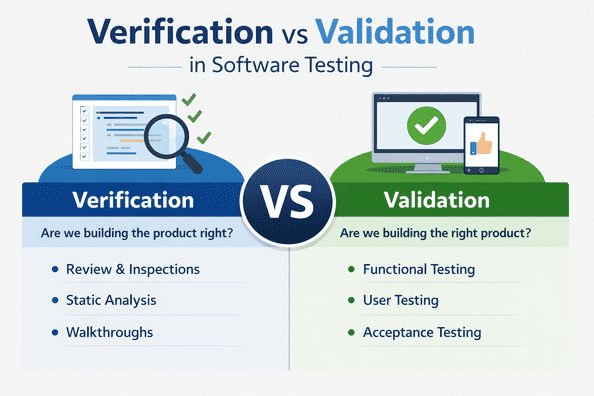
Verification is the process of evaluating software during development to ensure it complies with specifications and design requirements. The focus is on building the product right. Common verification activities include:
-
Code reviews and walkthroughs
-
Static analysis and inspections
-
Design and requirement checks
Verification answers the question: “Are we building the product correctly?”
Validation
Validation ensures that the finished software meets business goals and user needs. It focuses on testing the actual functionality in realistic scenarios. Common validation activities include:
-
Functional and system testing
-
User acceptance testing (UAT)
-
Performance and usability testing
Validation answers the question: “Are we building the right product?”
Challenges of Balancing Verification and Validation in DevOps
-
Rapid Release Cycles: Frequent updates make it difficult to allocate sufficient time for thorough verification and validation.
-
Complex Systems: Modern applications often include microservices, APIs, and third-party integrations that increase testing complexity.
-
Resource Constraints: Teams may have limited QA personnel or testing infrastructure, requiring prioritization of effort.
-
Risk of Overlapping Efforts: Without clear boundaries, verification and validation activities may overlap, leading to inefficiencies.
Strategies for Effective Balance
1. Prioritize Based on Risk
Not every feature has the same impact on end users or system stability. Teams should prioritize verification and validation efforts based on criticality:
-
Critical business workflows → full verification and validation
-
Minor UI changes → targeted validation
2. Integrate Testing Into CI/CD Pipelines
Continuous integration allows automated verification early in the development process, while continuous validation ensures that the system behaves correctly in real-world scenarios. This balance enables teams to catch defects early without slowing down releases.
3. Apply Automation Strategically
Test automation can handle repetitive verification and validation tasks, such as unit tests, integration tests, and regression suites. Automation ensures fast feedback and consistent coverage while freeing teams to focus on high-priority or exploratory validation activities.
4. Maintain Traceability
Link verification activities to requirements and validation activities to business outcomes. Traceability helps teams understand which tests are essential, reduces duplication, and ensures both aspects of quality are addressed.
5. Monitor Metrics and Adjust
Collect metrics on test coverage, defect density, and failure rates to evaluate the effectiveness of verification and validation. Use this data to continuously optimize the balance between the two practices.
Practical Applications in DevOps
-
API Development: Verification ensures endpoints follow specifications; validation confirms correct behavior under real-world usage.
-
Microservices: Independent services can be verified through automated unit tests, while system-wide validation ensures smooth integrations.
-
UI/UX Changes: Verification checks design adherence; validation ensures user workflows remain intuitive and functional.
Benefits of a Balanced Approach
-
Reduced production defects and rollback incidents
-
Increased confidence in releases despite fast-paced cycles
-
Efficient use of resources by targeting verification and validation where they matter most
-
Enhanced collaboration between developers, QA, and operations teams
Conclusion
Balancing verification vs validation efforts in fast-paced DevOps environments is essential for delivering high-quality software at speed. By prioritizing risk, integrating automated testing into CI/CD pipelines, maintaining traceability, and continuously monitoring metrics, teams can ensure both correctness and usability.
A strategic approach to verification and validation not only prevents defects from reaching production but also supports faster, more reliable releases, making it a critical practice for modern DevOps teams.
Categorii
Citeste mai mult
Merv Lee Kwai has transitioned from Amazon Game Studios to a pivotal leadership role at NCsoft America. His new position as Vice President of Operations will see him steering the global strategy for major titles. A key focus will be guiding the worldwide release of Aion 2 while overseeing live service games like Aion, Blade & Soul, and Lineage II. NC America's CEO highlighted Kwai's unique...

The Broken Planet Hoodie is a perfect way to share love this Valentine’s Day with purpose and style. Unlike ordinary gifts, it carries a deeper message of awareness, creativity, and connection. This Broken Planet Hoodie feels personal and intentional, making it ideal for expressing genuine emotion. It represents love that goes beyond trends and embraces values. Gifting it shows...

Completing a dissertation is one of the most demanding academic tasks for postgraduate students in the UK. For MBA students, the pressure is even greater because their research must combine academic theory with real world business practice. Marketing students, in particular, face challenges related to data analysis, strategy development, and industry relevance. This is why many students...

China's cinema landscape welcomes a digital leap with 'Star Wars: Episode II'. Set for a July 12 mainland premiere, this marks a swifter release following its global debut. It pioneers as the first foreign feature to be showcased digitally across Chinese theaters. This move aligns with efforts to combat piracy by reducing the window between international and local releases. The strategy proved...
Netflix Comedy Stars Reunite: Sandler and Rock Join Forces for 'The Week Of' Comedy legends Adam Sandler and Chris Rock are teaming up once again in an upcoming Netflix original film titled 'The Week Of.' The project marks another significant collaboration between the streaming giant and these comedy powerhouses who previously worked together on 'Grown Ups' and its sequel. Set to begin...