


Agricultural Micronutrients Market in Mexico: Analysis and Forecast 2025–2033
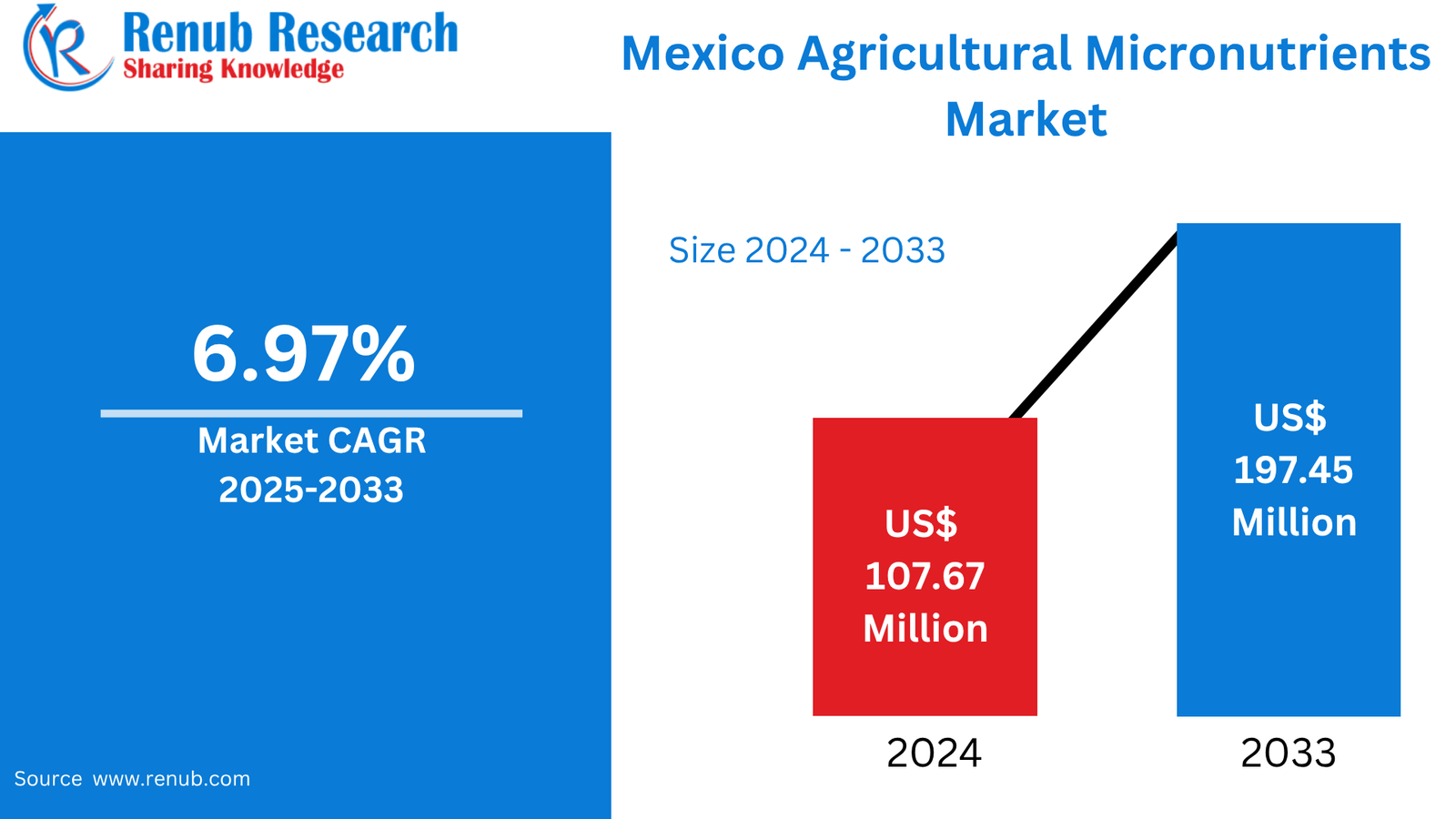
Mexico Agricultural Micronutrients Market Overview
According To Renub Research Mexico agricultural micronutrients market is gaining strategic importance as the country’s farming sector focuses on improving productivity, crop quality, and soil sustainability. Agricultural micronutrients such as zinc, boron, iron, manganese, molybdenum, and copper are required in small quantities, yet they play a decisive role in plant metabolism, enzyme activation, chlorophyll formation, and resistance to environmental stress. In Mexico, where soil conditions vary widely across regions, micronutrient deficiencies have become a recurring challenge affecting crop yield and quality.
Between 2025 and 2033, the Mexico agricultural micronutrients market is projected to expand steadily, growing from US$ 107.67 million in 2024 to around US$ 197.45 million by 2033. This growth reflects a compound annual growth rate of 6.97%, supported by increasing awareness among farmers, rising adoption of modern agricultural practices, and stronger emphasis on balanced crop nutrition. As food demand grows and farming systems evolve, micronutrients are transitioning from optional supplements to essential inputs in Mexican agriculture.
Download Free Sample Report:https://www.renub.com/request-sample-page.php?gturl=mexico-agricultural-micronutrients-market-p.php
Industry Landscape and Role of Micronutrients
Mexico’s diverse agricultural landscape, ranging from arid northern zones to tropical southern regions, creates varying soil fertility conditions. Many soils lack adequate levels of essential micronutrients due to intensive cultivation, erosion, and long-term reliance on macronutrient-heavy fertilizers. Micronutrients are increasingly recognized as critical for addressing these imbalances and supporting healthy plant development.
Key crops such as maize, sugarcane, fruits, vegetables, coffee, and oilseeds depend on micronutrients for improved yields and consistent quality. Zinc supports enzyme activity and growth regulation, boron aids flowering and fruit formation, iron is essential for chlorophyll synthesis, and manganese contributes to photosynthesis. As farmers gain better understanding of these functions, micronutrient application is becoming an integral part of crop nutrition strategies across Mexico.
Adoption of Advanced Agricultural Practices
The growing shift toward precision farming and sustainable agriculture is a major factor shaping the Mexico agricultural micronutrients market. Farmers are increasingly using soil testing, crop monitoring, and data-driven decision-making to apply nutrients more efficiently. Precision agriculture enables targeted micronutrient application, reducing waste while improving nutrient uptake by crops.
Technological advancements in micronutrient formulations, such as chelated and water-soluble products, have further improved effectiveness. These formulations enhance nutrient availability and compatibility with modern irrigation systems, including fertigation and foliar spraying. As sustainability becomes a priority, micronutrients are being used to improve soil health, reduce overuse of chemical fertilizers, and support long-term agricultural productivity.
Awareness of Soil Nutrient Deficiencies
One of the strongest drivers of market growth is the increasing identification of micronutrient deficiencies in Mexican soils. Farmers, agribusinesses, and agricultural researchers are placing greater emphasis on soil diagnostics and nutrient management. Deficiencies of zinc, iron, and boron are common in several regions and can severely limit crop growth if left unaddressed.
Educational initiatives led by private companies, cooperatives, and extension services are helping farmers understand the economic benefits of micronutrient use. As a result, both large-scale commercial farms and smaller producers are beginning to incorporate micronutrients into their fertilizer programs. This trend is strengthening demand for tailored micronutrient solutions suited to local soil and crop conditions.
Demand for Higher-Quality and Nutrient-Rich Crops
Changing consumer preferences are also influencing the Mexico agricultural micronutrients market. Demand for high-quality, nutrient-rich food products is rising in both domestic and export markets. Micronutrients directly influence crop characteristics such as taste, color, texture, shelf life, and nutritional value, making them essential for producing premium agricultural goods.
Fruits and vegetables, in particular, benefit significantly from balanced micronutrient application, enhancing their competitiveness in health-conscious and urban markets. Food processors and agribusiness buyers increasingly encourage farmers to adopt improved nutrition practices to meet quality standards. As market incentives align with better crop nutrition, micronutrient use is evolving into a value-added farming strategy rather than solely a corrective measure.
Challenges Related to Farmer Awareness
Despite growing momentum, limited farmer education remains a major challenge for the Mexico agricultural micronutrients market. Many small and medium-scale farmers continue to prioritize macronutrients such as nitrogen, phosphorus, and potassium while overlooking the importance of micronutrients. This knowledge gap is often linked to restricted access to agronomic advice, soil testing services, and training programs.
Without adequate understanding of micronutrient benefits, adoption rates remain uneven across regions. Addressing this challenge requires coordinated efforts from government agencies, private agritech firms, and farmer cooperatives. Training programs, demonstration farms, and localized extension services are essential to improving awareness and encouraging informed nutrient management decisions.
Regulatory and Product Quality Constraints
Inconsistent regulation and variable product quality present additional obstacles to market growth. Inadequate enforcement of quality standards can result in mislabeled or diluted products entering the market, reducing farmer confidence and limiting repeat adoption. When micronutrient products fail to deliver expected results, farmers may become reluctant to invest further.
The absence of uniform guidelines on application rates, labeling, and safety information complicates proper usage. Strengthening regulatory frameworks, implementing standardized quality controls, and improving transparency across the supply chain are critical for building long-term trust in the micronutrients market. Reliable regulation also encourages responsible manufacturers to invest in innovation and farmer support.
Regional Dynamics of the Mexico Agricultural Micronutrients Market
The adoption of agricultural micronutrients varies significantly across Mexico due to differences in climate, soil composition, crop patterns, and infrastructure. Each region presents unique growth opportunities and challenges that shape overall market performance.
Northern Mexico Agricultural Micronutrients Market
Northern Mexico represents a fast-growing segment of the agricultural micronutrients market. The region’s arid climate and alkaline soils often lead to deficiencies in zinc, iron, and boron. Commercial farming dominates this region, with crops such as cotton, grapes, vegetables, and forage crops requiring precise nutrient management.
Farmers in northern Mexico increasingly rely on micronutrient-enriched fertilizers and soil amendments to improve crop resilience and yields. The use of precision agriculture tools, including soil testing and targeted application, is enhancing nutrient efficiency. Although access to technical support and high-quality products remains uneven, public and private initiatives are steadily improving adoption levels.
Central Mexico Agricultural Micronutrients Market
Central Mexico is one of the most important regions for agricultural micronutrient consumption due to its fertile land and diverse crop production. Grains, fruits, and vegetables grown in this region benefit from balanced nutrient management, making micronutrients a key input for sustaining productivity.
Farmers in central Mexico are increasingly adopting modern farming techniques such as precision application and fertigation. Awareness of the role of micronutrients in maintaining soil fertility and crop quality is relatively high compared to other regions. While challenges related to education and product distribution persist, strong agricultural infrastructure supports continued market expansion.
Southern Mexico Agricultural Micronutrients Market
Southern Mexico is characterized by diverse cropping systems, including tropical fruits, coffee, cacao, and avocados. These crops require balanced micronutrient nutrition to achieve optimal growth and quality. Awareness of micronutrient benefits is gradually increasing, supported by agricultural development programs and extension services.
However, adoption remains inconsistent due to limited access to quality inputs and uneven application practices. Regional disparities in infrastructure and distribution networks also affect market penetration. Addressing these constraints through region-specific solutions and improved farmer outreach is essential for unlocking the full potential of the southern Mexico agricultural micronutrients market.
Market Segmentation by Form and Application
The Mexico agricultural micronutrients market is segmented by form into chelated and non-chelated products. Chelated micronutrients are gaining preference due to their higher stability, improved absorption, and compatibility with advanced application methods. Non-chelated products continue to be used where cost considerations dominate, particularly among small-scale farmers.
By application, soil treatment remains the most common method, followed by foliar application and fertigation. Foliar spraying is increasingly popular for correcting deficiencies quickly, while fertigation offers efficient nutrient delivery in irrigated farming systems. The growing adoption of modern irrigation infrastructure supports demand for advanced application methods.
Competitive Landscape and Key Market Participants
The competitive environment of the Mexico agricultural micronutrients market includes a mix of global and regional companies offering diverse product portfolios. Major players focus on product innovation, farmer education, and strategic partnerships to strengthen their market presence. Key participants include BASF SE, Compass Minerals, Coromandel International, Deepak Fertilisers, Nouryon, Nufarm, Nutrien Ltd., The Mosaic Company, and Yara International.
These companies emphasize research-driven solutions, region-specific formulations, and technical support to address Mexico’s diverse agricultural needs. Competitive strategies increasingly revolve around sustainability, efficiency, and farmer-centric services.
Future Outlook of the Mexico Agricultural Micronutrients Market
Looking ahead, the Mexico agricultural micronutrients market is expected to maintain steady growth through 2033. Rising awareness of soil health, increasing adoption of precision agriculture, and growing demand for high-quality crops will continue to drive market expansion. While challenges related to education, regulation, and access persist, ongoing investments in training, infrastructure, and quality assurance are likely to strengthen market foundations.
As Mexican agriculture adapts to climate pressures, resource constraints, and evolving consumer expectations, micronutrients will play an increasingly vital role in supporting sustainable and productive farming systems.
Catégories
Lire la suite
A new creative partnership is taking shape at the global streaming giant. Darla Anderson, the celebrated producer behind Pixar's greatest hits, is bringing her visionary talents to Netflix. Her mission? To craft original animated and live-action stories for families across the globe. Anderson's legacy is built on groundbreaking work. She championed the all-Latino cast of the Oscar-winning...

Maintaining healthy blood sugar levels is one of the most important—and challenging—parts of modern wellness. With today’s fast-paced lifestyles, processed foods, chronic stress, and lack of physical activity, blood sugar imbalance has become increasingly common. Millions of people experience energy crashes, cravings, stubborn weight gain, and long-term metabolic concerns...

Leading entertainment choices for home viewing in the first half of 2002 reflected significant consumer investment in DVD and VHS formats. Sales and rental figures through June 30th highlighted the most popular titles. This period showcased the evolving market for physical media purchases and leases. The data provides a snapshot of viewer preferences and spending habits mid-year. Based on the...
Unwanted facial hair can affect confidence and overall appearance, especially when it appears on visible areas like the chin. At Moons Day SPA, we understand how important smooth, clean skin is for your self-care routine. That’s why we specialize in professional Chin Threading or Waxing, offering safe, hygienic, and long-lasting hair removal solutions tailored to your skin type. As a...

В рамках обновлений для Mobile Legends: Bang Bang разработчики представили уникальный скин для героя Novaria, получивший название «Lunar Scion». Анонс нового образа был опубликован в официальных соцсетях игры и сопровождается коротким видеотизером, который сразу привлёк внимание поклонников. Образ «Lunar Scion» тесно связан с лором чемпионата M, в котором Novaria...