


BIS Certification Guide: Certificate, License & Registration
Introduction
In India, product quality and safety are extremely important for both consumers and manufacturers. To ensure that products meet required standards, the government has made it mandatory for certain products to obtain a BIS Certificate. The Bureau of Indian Standards (BIS) is responsible for setting quality benchmarks and issuing certifications. If you are a manufacturer or importer, understanding BIS Certification, BIS License, BIS Licence, and BIS Registration is essential to legally sell your products in the Indian market.
What is BIS Certificate?
A BIS Certificate is an official document issued by the Bureau of Indian Standards that confirms a product meets Indian quality and safety standards. It ensures that consumers receive reliable and safe products. This certification is mandatory for many products like electronics, cement, steel, and household appliances. Without a valid certificate, these products cannot be sold in India.
What is BIS Certification?
BIS Certification is the complete process through which a product is tested, inspected, and approved according to Indian standards.
The main goal of BIS Certification is to:
-
Ensure product safety
-
Maintain quality standards
-
Protect consumers
-
Promote fair trade practices
Once the certification is approved, manufacturers can use the ISI mark or CRS registration mark on their products.
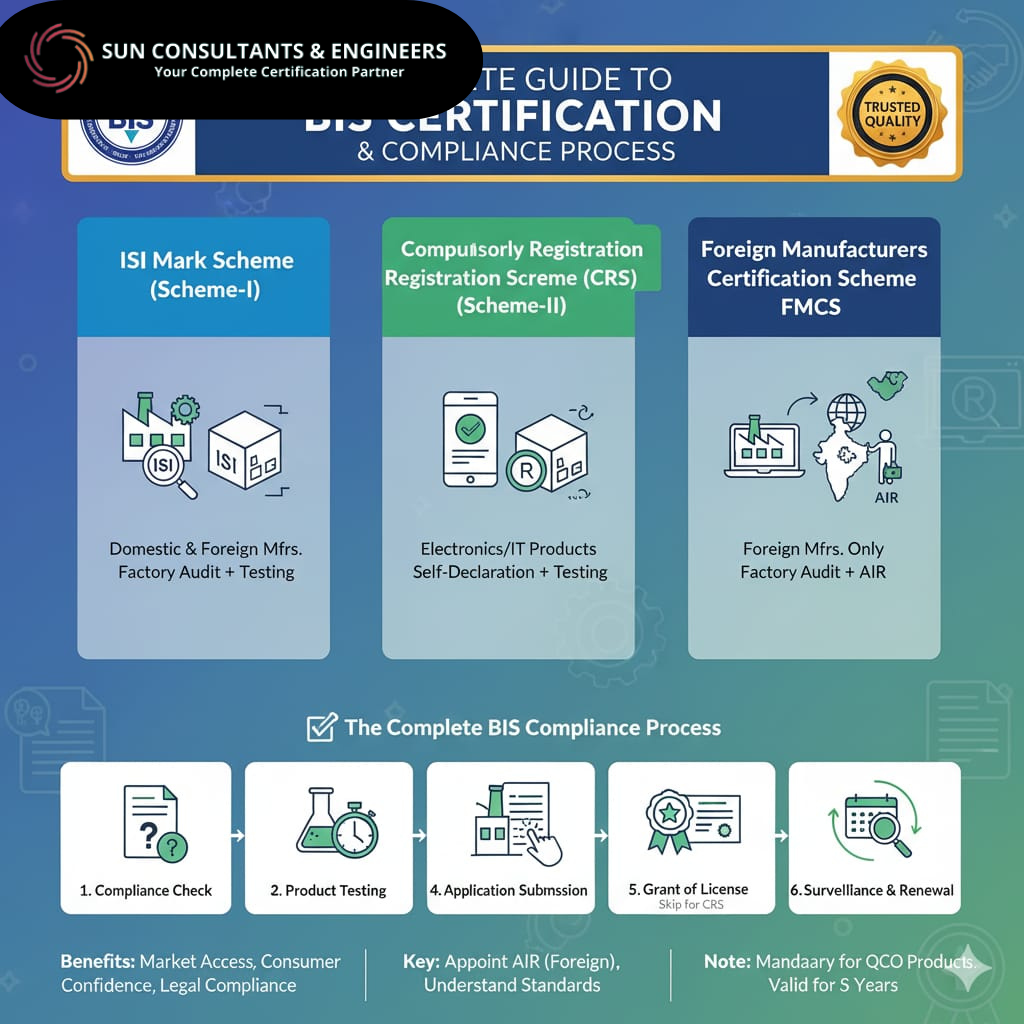
Types of BIS Certification
There are different types of BIS Certification depending on the product and manufacturer:
1. ISI Mark Certification
This is for domestic manufacturers and is one of the most recognized marks in India.
2. CRS (Compulsory Registration Scheme)
Applicable mainly to electronics and IT products.
3. FMCS (Foreign Manufacturers Certification Scheme)
This applies to foreign manufacturers who want to export products to India.
What is BIS License / BIS Licence?
A BIS License (also written as BIS Licence) is the authorization granted to manufacturers after successful certification. It allows them to use the BIS standard mark on their products.
The BIS License ensures that:
-
The product complies with Indian standards
-
Regular quality checks are maintained
-
The manufacturer follows BIS guidelines
Without a valid license, using the BIS mark is illegal and can lead to penalties.
What is BIS Registration?
BIS Registration is mainly used under the Compulsory Registration Scheme (CRS). It is required for electronic and IT products such as:
-
Mobile phones
-
LED lights
-
Laptops
-
Power banks
Manufacturers must register their products before selling them in India. This process involves product testing in BIS-approved labs and submitting documents for approval.
Documents Required for BIS Certification
To obtain a BIS Certificate, you need the following documents:
-
Business registration certificate
-
Manufacturing unit details
-
Product details and specifications
-
Test reports from BIS-approved labs
-
Quality control documents
-
Authorized signatory details
Having complete and accurate documentation speeds up the approval process.
BIS Certification Process
The process for obtaining BIS Certification includes several steps:
Step 1: Application Submission
Submit the application with all required details and documents.
Step 2: Product Testing
The product is tested in a BIS-recognized laboratory.
Step 3: Factory Inspection
BIS officials may inspect the manufacturing unit.
Step 4: Evaluation
All reports and documents are verified.
Step 5: Grant of BIS License
After successful verification, the BIS License is issued.
Benefits of BIS Certification
Getting a BIS Certificate offers multiple advantages:
1. Legal Compliance
Helps you meet government regulations and avoid penalties.
2. Consumer Trust
Customers prefer products with BIS marks as they ensure safety and quality.
3. Market Access
Mandatory certification allows you to sell products legally in India.
4. Brand Value
Improves your brand reputation and credibility.
5. Competitive Advantage
Certified products stand out in the market.
Products Covered Under BIS Certification
Some commonly certified products include:
-
Electrical appliances
-
Steel and cement products
-
Automotive components
-
Electronics and IT goods
-
Packaged drinking water
The government regularly updates the list of mandatory products.
Common Challenges in BIS Certification
While applying for BIS Registration or certification, businesses may face challenges such as:
-
Complex documentation
-
Delays in testing and approvals
-
Technical compliance issues
-
Lack of knowledge about standards
Proper guidance can help overcome these issues easily.
Conclusion
Obtaining a sunconsultants.co.in, BIS Certification, BIS License, BIS Licence, and BIS Registration is essential for manufacturers and importers who want to operate legally in India. It not only ensures product quality and safety but also builds trust among consumers. Although the process may seem complicated, following the correct steps and maintaining proper documentation can make it smooth and hassle-free. Investing in BIS certification is a smart move for long-term business success and market growth.
Categorii
Citeste mai mult
Hohe Angriffskraft Der Woodpecker Elektro ist eine spezielle Antriebsscheibe, die darauf ausgelegt ist, Agenten mit Fokus auf hohen Angriffsschaden zu stärken. Durch die Verwendung dieser Scheibe steigt die Angriffskraft der Agenten deutlich an, was ihnen erlaubt, im Kampf erheblich mehr Schaden zu verursachen. Sie ist besonders geeignet für aggressive Strategien und unterstützt...

A spectral surprise arrives just as spooky season begins ' Gold members of the club are granted a ghostly advantage A 24-hour head start commences at the witching hour On the twenty-eighth of October, the quest shall begin ' Solve the riddle first to uncover where this pin is kept In true Hogwarts style, a challenge must be met Only then can you attempt to claim this collectible ' Crafted in...
Magis TV is a powerful Android streaming application that allows users to watch live TV channels, movies, TV series, and sports events in one place. As online streaming continues to replace traditional cable services, Magis TV has become a popular choice for users looking for a flexible and affordable entertainment solution. With its user-friendly interface, smooth playback, and large content...
Introduction: Welcome to the New FUTBIN FC 26 Player Page Discover the newly launched FC 26 player pages on FUTBIN, designed to enhance your experience through major improvements inspired by community suggestions. You’ll notice a refreshed interface and upgraded features, all tailored to make navigating player stats and information smoother than ever. Explore these enhancements and see...
Getting a tattoo is an exciting experience, but proper aftercare is essential to protect your skin and preserve your artwork. Fresh tattoos are essentially open wounds, Tattoo care products and sensitive skin requires extra attention during the healing process. Choosing the right aftercare solution can make a noticeable difference in comfort, healing speed, and long-term...
