As urban density increases and utilities face higher reliability and safety requirements, aerial bundle cable (ABC) has become one of the most trusted solutions for low- and medium-voltage overhead distribution systems. For engineers, EPC contractors, and utility procurement teams, choosing the right ABC supplier is no longer only about price it is about long-term network performance, installation efficiency, and operational safety.
As a global manufacturer of overhead conductors and power cables, HNBF Power provides engineered aerial bundle cable solutions designed specifically for utility and infrastructure projects across demanding environments.
What Is Aerial Bundle Cable?
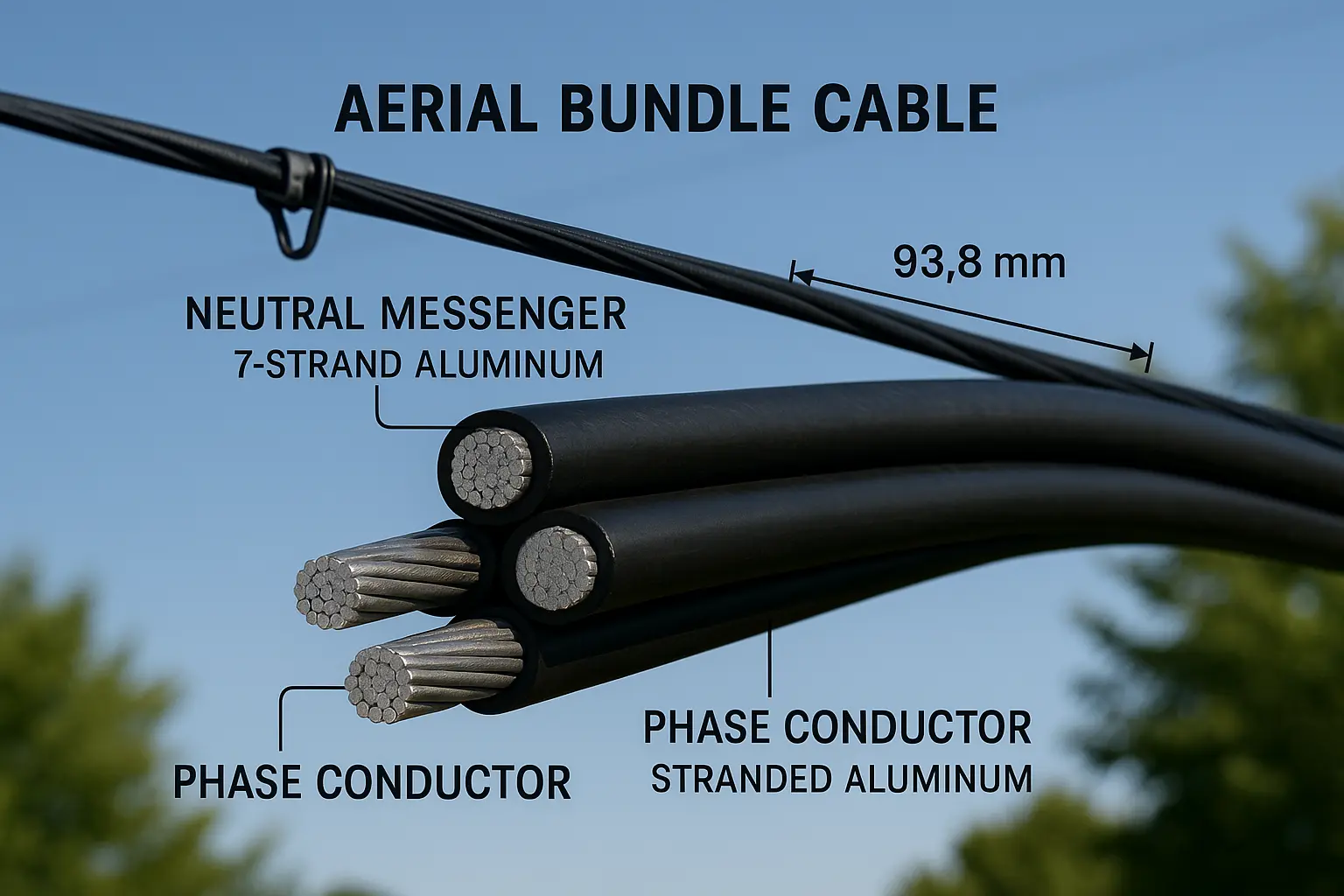
Aerial bundle cable is an overhead insulated cable system in which multiple phase conductors, and in most designs a neutral messenger conductor, are bundled together into a compact assembly.
Unlike traditional bare conductors, aerial bundle cable uses high-performance insulation commonly cross-linked polyethylene (XLPE) to significantly reduce electrical hazards, accidental contacts, and line-to-line faults.
In modern distribution networks, ABC is widely used for:
-
Low-voltage distribution lines
-
Service connections to residential and commercial users
-
Temporary or fast-deployment power networks
-
Urban and semi-urban grid upgrades
For utilities upgrading aging bare conductor systems, aerial bundle cable offers a practical and cost-effective transition toward safer overhead infrastructure.
Key Technical Structure of Aerial Bundle Cable
Phase Conductors
The phase conductors are typically stranded aluminum conductors insulated with weather-resistant XLPE. The insulation allows closer phase spacing without the risk of flashover or short circuit.
Neutral Messenger Conductor
In most LV aerial bundle cable systems, the neutral messenger also serves as the mechanical support for the entire bundle. It carries the tensile load while maintaining the correct conductor geometry along the span.
Compact Bundled Design
The bundled configuration improves wind stability and reduces conductor swing. This is especially important in urban distribution corridors and roadside installations.
Why Utilities Are Shifting to Aerial Bundle Cable
Improved Network Safety
One of the most important benefits of aerial bundle cable is reduced public safety risk. The fully insulated phase conductors minimize accidental contact with trees, buildings, or maintenance equipment.
For utilities operating in dense residential areas, ABC helps meet modern safety compliance requirements while lowering liability exposure.
Higher Reliability in Harsh Environments
Aerial bundle cable performs significantly better than bare conductors in:
-
Coastal and high-humidity regions
-
Industrial pollution zones
-
Areas with vegetation encroachment
-
Wind-prone and storm-affected regions
The insulation layer protects against surface tracking, moisture ingress, and short-circuit faults caused by external contact.
Reduced Power Loss and Fault Rates
Because of improved insulation integrity and stable conductor spacing, ABC systems experience fewer line faults, fewer outage events, and more stable operational performance over long service life.
Installation Advantages for EPC and Utility Contractors
Faster Deployment
Aerial bundle cable is easier to string and clamp than traditional open-wire systems. With the neutral messenger acting as a load-bearing conductor, line installation becomes more predictable and less labor-intensive.
Simplified Hardware and Accessories
Modern ABC systems use standardized suspension clamps, anchoring systems, and insulation piercing connectors. This simplifies inventory management and speeds up site installation.
Better Right-of-Way Utilization
The compact design allows tighter clearances and more flexible routing along poles and structures an important advantage for urban grid renovation projects and road expansion programs.
Typical Applications of Aerial Bundle Cable
Low Voltage Distribution Networks
Aerial bundle cable is widely used in 0.6/1 kV distribution systems supplying residential communities, commercial buildings, and light industrial facilities.
Service Drops and Last-Mile Connections
Utilities increasingly use ABC for service connections from the main line to end users due to its safety and reliability.
Temporary and Mobile Power Systems
For construction sites, emergency power restoration, and infrastructure projects, ABC provides fast deployment with reduced site risk.
Engineering Considerations When Selecting Aerial Bundle Cable
Conductor Size and Current Rating
Proper sizing of phase and neutral conductors is critical for controlling voltage drop, thermal limits, and future load growth.
Insulation Grade and Weather Resistance
In outdoor distribution environments, UV resistance, temperature class, and environmental aging performance must meet long-term operational requirements.
Mechanical Load and Span Length
The tensile strength of the neutral messenger conductor must be selected based on span length, terrain, and local wind and ice loading conditions.
How HNBF Power Supports Utility and EPC Projects
HNBF Power supplies a full portfolio of aerial bundle cable systems designed for utility-grade power distribution projects. Its manufacturing capabilities cover:
-
LV aerial bundle cable systems
-
Insulated aluminum conductors
-
Neutral messenger conductors with optimized mechanical performance
-
Custom conductor constructions for regional grid standards
By working closely with engineering teams and procurement departments, HNBF Power delivers tailored ABC configurations that match project-specific requirements for electrical performance, installation methods, and long-term network reliability.
Frequently Asked Questions (FAQs)
1. What is the main difference between aerial bundle cable and bare conductor systems?
Aerial bundle cable uses fully insulated phase conductors bundled together, while bare conductor systems rely on air spacing for insulation. ABC provides much higher safety and fault resistance.
2. Is aerial bundle cable suitable for high-density urban areas?
Yes. The compact structure, reduced clearance requirements, and improved safety performance make ABC ideal for urban and semi-urban distribution networks.
3. Can aerial bundle cable reduce maintenance costs?
In most utility networks, ABC significantly lowers vegetation-related faults and accidental contact incidents, which reduces both corrective maintenance and outage response costs.
4. What voltage levels are typically used for aerial bundle cable?
Aerial bundle cable is most commonly used in low-voltage and secondary distribution networks, especially for residential and commercial supply lines.
Final Thoughts: Building Safer and More Reliable Overhead Networks
As utilities and EPC contractors continue to modernize overhead distribution infrastructure, aerial bundle cable has become a proven solution for improving safety, reducing outages, and simplifying installation.
If your next project requires reliable, utility-grade aerial bundle cable solutions tailored to real field conditions, contact HNBF Power today to discuss your technical requirements and receive customized product configurations for your distribution network projects.