


US Cookies Market Report by Product, Ingredient & Sales Channel 2025
United States Cookies Market Overview
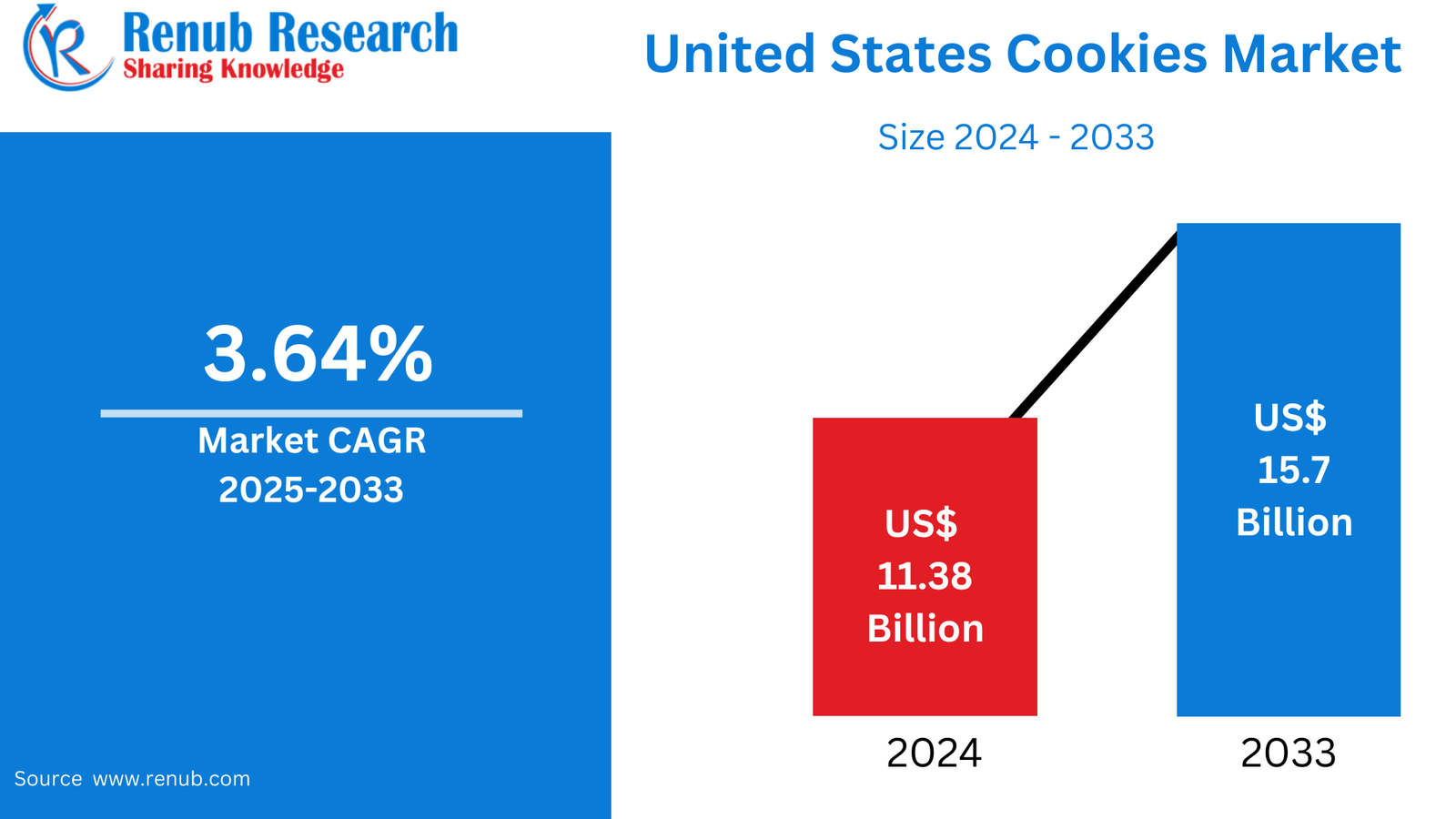
According To Renub Research United States Cookies Market represents one of the most mature and resilient segments of the broader bakery and packaged snacks industry. Valued at US$ 11.38 billion in 2024, the market is projected to reach US$ 15.7 billion by 2033, expanding at a compound annual growth rate (CAGR) of 3.64% from 2025 to 2033. This steady growth is supported by strong consumer demand for indulgent snacks, evolving dietary preferences, product innovation, and the rapid expansion of digital and omnichannel retail formats.
Cookies remain deeply embedded in American consumption culture, serving as comfort foods, on-the-go snacks, and increasingly, meal-replacement or breakfast-adjacent products. While traditional flavors such as chocolate chip and oatmeal continue to dominate volumes, newer categories focused on health, functionality, sustainability, and premiumization are reshaping competitive dynamics across the country.
Download Free Sample Report:https://www.renub.com/request-sample-page.php?gturl=united-states-cookies-market-p.php
United States Cookies Industry Outlook
The U.S. cookie industry is characterized by high brand loyalty, extensive retail penetration, and continuous innovation. Established multinational manufacturers coexist with regional bakeries, artisanal brands, and direct-to-consumer startups, creating a highly competitive yet diversified marketplace.
Consumer preferences are shifting toward clean-label, organic, gluten-free, plant-based, and low-sugar formulations. At the same time, indulgence remains a core purchase driver, resulting in a dual-market structure where premium health-oriented cookies and classic mass-market products grow simultaneously.
Major food companies such as Mondelez International Inc., Campbell Soup Company, and Ferrero Group continue to dominate shelf space, while niche brands leverage social media, influencer marketing, and subscription models to build loyal customer bases.
Key Factors Driving Growth in the United States Cookies Market
Expansion of Urban On-the-Go Consumption
Urbanization and changing work patterns are significantly influencing cookie consumption habits in the United States. Time-constrained consumers increasingly favor portable, ready-to-eat foods that require minimal preparation. Cookies are benefiting from this shift as they are repositioned from traditional dessert items to convenient snacks and even breakfast alternatives.
This trend is particularly pronounced in metropolitan areas along the Northeast and West Coast, where commuting lifestyles and flexible remote work schedules blur conventional meal boundaries. Manufacturers are responding with breakfast-positioned cookies featuring whole grains, fiber, protein enrichment, and reduced sugar content. By expanding usage occasions beyond snacking, brands are unlocking incremental volume growth.
Ingredient Innovation and Plant-Based Reformulation
Ingredient reformulation is playing a pivotal role in modernizing the U.S. cookies market. Manufacturers are increasingly replacing conventional butter and shortening with plant-based fat alternatives that align with sustainability goals and dietary preferences. These reformulations aim to preserve taste and texture while reducing environmental impact.
Demand for plant-based cookies is strongest among younger consumers in environmentally conscious states, particularly California and Washington. However, sourcing stable and cost-effective plant-based fats while maintaining sensory quality remains a key operational challenge for producers.
Rising Demand for Portion-Controlled Indulgence
Consumers are demonstrating a growing preference for portion-controlled indulgence, where enjoyment and moderation coexist. Mini cookies, single-serve packs, and resealable packaging formats are gaining popularity, particularly among health-conscious professionals and families.
This trend supports premium pricing strategies, as consumers are increasingly willing to pay more for controlled portions that fit wellness-oriented lifestyles. Seasonal collections, gift packaging, and limited-edition assortments further enhance perceived value while driving impulse purchases.
Challenges in the United States Cookies Market
Increasing Health-Conscious Consumer Pressure
Health awareness presents a dual challenge for cookie manufacturers. While it creates opportunities for innovation, it also places pressure on traditional formulations. Consumers are increasingly seeking cookies that are vegan, gluten-free, low in sugar, and made with recognizable ingredients.
Reformulating classic recipes without compromising taste, texture, shelf life, or brand identity is complex and costly. Specialty ingredients such as almond flour, coconut sugar, and alternative sweeteners increase production costs and complicate supply chains, particularly for large-scale manufacturers.
Volatility in Ingredient Costs
Rising and volatile prices for key raw materials such as wheat, sugar, cocoa, dairy, and packaging materials pose a major challenge to market stability. Inflation, climate-related agricultural disruptions, and global supply chain inefficiencies have amplified cost pressures.
Manufacturers face difficult decisions between absorbing costs, increasing prices, reducing portion sizes, or reformulating products. In a price-sensitive and highly competitive market, missteps can negatively impact brand loyalty and sales volumes.
United States Cookies Market Segmentation Analysis
By Ingredient
Chocolate and chocolate chip cookies continue to dominate the U.S. market due to their universal appeal and strong brand heritage. Oatmeal, butter, and cream-based cookies follow closely, while ginger, coconut, honey, and specialty ingredient cookies cater to niche and seasonal demand.
Health-oriented ingredients such as oats, nuts, seeds, and natural sweeteners are gaining share as consumers seek functional and better-for-you alternatives.
By Product Type
Drop cookies and sandwich cookies represent the largest product categories, supported by mass-market brands and extensive retail availability. Bar cookies and molded cookies are popular in seasonal and gifting segments, while no-bake and icebox cookies appeal to home bakers and convenience-driven consumers.
Product differentiation through texture, filling, and size continues to be a key competitive lever.
By Packaging
Flexible packaging dominates due to its cost efficiency, shelf-life benefits, and convenience. However, rigid packaging is gaining traction in premium and gifting categories, where aesthetics and reusability enhance brand perception.
Sustainable and recyclable packaging solutions are increasingly influencing purchasing decisions, particularly among younger demographics.
By Sales Channel
Offline retail channels, including supermarkets, hypermarkets, and convenience stores, remain the primary sales drivers. However, online channels are growing rapidly due to the expansion of e-commerce grocery platforms, direct-to-consumer websites, and subscription snack services.
Digital channels enable better consumer engagement, data collection, and targeted marketing strategies.
United States Cookies Market by State
California Cookies Market
California represents one of the most dynamic cookie markets in the United States. Strong demand for organic, vegan, gluten-free, and clean-label products positions the state as a hub for innovation. Artisanal bakeries, health food retailers, and farmers’ markets play a significant role alongside mainstream grocery chains.
The state’s diverse population drives demand for fusion flavors and globally inspired cookie varieties, while sustainability remains a critical purchasing factor.
Texas Cookies Market
Texas is a high-volume, fast-growing cookie market supported by population growth and strong retail infrastructure. Traditional flavors such as chocolate chip and sugar cookies dominate, but there is growing interest in locally inspired and premium offerings.
While health-conscious trends are emerging in urban centers, indulgent cookies continue to perform strongly across the state, supported by wide distribution through supermarkets and convenience stores.
New York Cookies Market
New York’s cookie market is trend-driven, premium-oriented, and highly competitive. Urban consumers prioritize quality, novelty, and visual appeal, fueling demand for gourmet, filled, and specialty cookies.
High population density, strong delivery infrastructure, and digital ordering platforms make New York a prime market for direct-to-consumer brands and experimental product launches.
Recent Developments in the U.S. Cookies Industry
In mid-2025, collaborative product innovation between major snack brands introduced hybrid cookie and confectionery formats, reinforcing indulgence-driven growth. Additionally, chilled and bake-at-home cookie dough products gained popularity, allowing consumers to recreate bakery-style experiences at home.
Premium brands also expanded into new texture profiles, demonstrating how established players continue to evolve while preserving brand equity.
Competitive Landscape and Company Analysis
The United States cookies market is highly competitive, with a mix of multinational corporations, regional manufacturers, and niche brands. Key players compete on brand recognition, distribution reach, product innovation, pricing strategies, and sustainability initiatives.
Notable companies operating in the market include:
· Mondelez International Inc.
· Ferrero Group
· Campbell Soup Company
· Girl Scouts of the USA
· McKee Foods Corporation
· Grupo Bimbo
· General Mills Inc.
· PepsiCo Inc.
· Meiji Holdings Co. Ltd
· Hostess Brands LLC
Each company is evaluated based on market overview, leadership structure, recent developments, SWOT analysis, and revenue performance to assess competitive positioning.
Conclusion
The United States cookies market is positioned for stable, long-term growth through 2033, supported by evolving consumer lifestyles, product innovation, and expanding digital retail ecosystems. While health-conscious trends and cost pressures present challenges, they also create opportunities for differentiation and premiumization.
Manufacturers that successfully balance indulgence with wellness, leverage sustainable practices, and adapt to omnichannel distribution models will be best positioned to capture future growth. As cookies continue to evolve from simple treats into versatile lifestyle products, the U.S. market will remain one of the most influential and innovative globally.
Categorías
Read More
Production Begins on Louisiana-Based Crime Drama Principal photography has officially commenced in Louisiana for the highly anticipated Netflix film directed by John Lee Hancock, known for acclaimed works such as "The Blind Side" and "The Founder." The production features an impressive ensemble cast headlined by Kevin Costner and Woody Harrelson, both bringing their considerable talents to...

Moving can be stressful, especially when you’re worried about your furniture getting scratched, dented, or damaged. Luckily, there’s a simple solution that makes a huge difference. Moving Furniture Pads are one of the easiest ways to protect your belongings during a move. Why Protecting Furniture Matters Before you start wrapping anything, it’s important to understand why...

Slicing bread might seem like a simple kitchen task, but anyone who has struggled with a dull knife knows the frustration of squashed loaves, uneven slices, and messy presentation. Whether you’re a home baker or a professional chef, having the right tool is crucial. A Damascus Bread Knife is designed to make bread slicing effortless, precise, and enjoyable, transforming a simple kitchen...

Recent updates to Marvel Rivals have brought notable improvements to Spider-Man’s iconic costume, addressing fan concerns over its previous over-the-top design. One of the most visible changes is the removal of his exaggerated trainers, which previously clashed with his sleek, superhero aesthetic. The new footwear now seamlessly integrates with the overall look, featuring web-line...
Разработчики продолжают совершенствовать защиту от нечестной игры, уделяя особое внимание обратной связи от сообщества. ' Помимо работы над ложными блокировками, команда сосредоточена на новых вызовах. ' Использование сторонних контроллеров на консолях остаётся проблемой, нарушающей баланс. ' Реклама читов в голосовом чате также вредит атмосфере честного соперничества. ' Борьба с программами,...